What is it and why is it so important?
A guide for health professionals
Overview
Most people will recognise iodine from science experiments in school, but it is also an essential micronutrient that has many roles in the body.
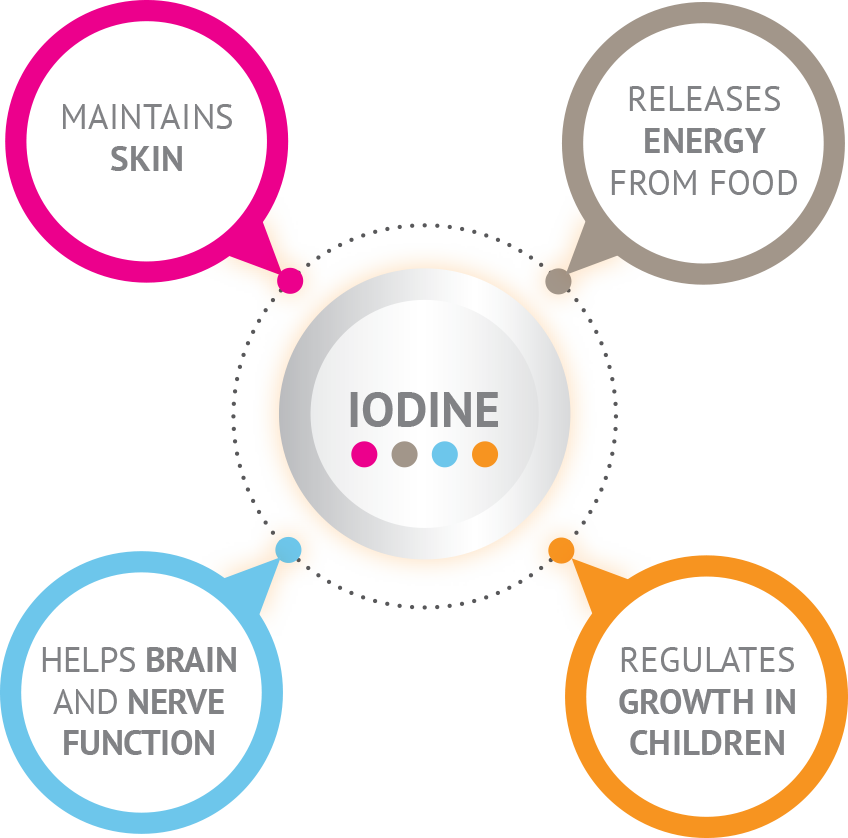
Iodine makes up part of the thyroid hormones which help release energy from food and regulate growth in children. They also contribute to brain and nerve function, and help maintain skin health.
A little bit of history
Certain population groups in the UK are classified as mildly iodine deficient by the World Health Organisation. During the 1800s and 1900s iodine deficiency was common in some parts of the UK. Goitre was common in many parts of Britain, including South-West England and Wales; it was so common in the Peak District that it was termed ‘Derbyshire Neck’.
Goitre is a condition where the thyroid gland becomes enlarged due to insufficient or excess iodine. Iodine deficiency can lead to thyroid dysfunction, including both hypothyroidism and hyperthyroidism. Symptoms of hypothyroidism include weight gain, dry skin, hair loss, tiredness, depression and intolerance to cold.

DON’T GET ENOUGH IODINE FROM FOOD SOURCES*
Studies have found mild iodine deficiency in some UK teenage girls and pregnant women.
* Data from the National Diet & Nutrition Survey
Growth and development
Pregnancy and breastfeeding
During pregnancy the thyroid hormones play a role in brain development and growth of the unborn baby. Severe iodine deficiency in pregnancy, which is rare in the UK, can compromise brain development leading to problems with cognition, hearing, speech and growth. Mild-to-moderate iodine deficiency in pregnancy has been linked to lower IQ and reading ability in children.
It’s a good idea for women to consume enough iodine whether planning a baby or not, as pregnancies can often be unplanned.
However, too much iodine can also cause problems and it is important to avoid excessive intake of iodine.
Childhood and adolescence
Children and teenagers grow and develop rapidly up until the age of around 18 years.
Iodine forms part of the thyroid hormones which are responsible for regulating metabolic rate, as well as physical and mental development in children and teenagers. Poor intakes during childhood may be linked to a low IQ and poor physical growth.
Dairy and iodine
The iodine content of foods can vary depending on the soil or waters in which they were grown.
Animals that graze on grass from nutrient poor soil are also at risk of becoming deficient in iodine. In fact, in the 1930s dairy farmers in the UK added iodine to cattle feed to improve animal health. This resulted in an increase in the iodine content of milk and dairy products. These days, dairy foods contribute more iodine to our diets than any other food group.
Consuming milk, yogurt and cheese is a great way to help to meet iodine requirements. There are small differences in the iodine content between whole, semi-skimmed or skimmed milk. Levels vary throughout the year and can range from 23μg – 28μg per 100g.
The table on the next page shows the recommended iodine intake at different stages in life, and the portion sizes of dairy that can help meet those needs.
Iodine recommendations by age group
Pregnancy & Breastfeeding
The Department of Health recommendation for pregnant and breastfeeding women is the same as for adults (140µg/day). However, WHO recommends 250µg/day.
Age 1-3 years
Iodine needs (RNI*) 70µg/day
PORTION SIZE:
100ml whole milk
IODINE CONTENT:
24µg
PORTION SIZE:
60g whole plain yogurt
IODINE CONTENT:
38µg
PORTION SIZE:
15g Cheddar cheese
IODINE CONTENT:
4.5µg
These portion sizes provide approximately 66.5µg of Iodine
Age 4-6 years
Iodine needs (RNI*) 100µg/day
PORTION SIZE:
A small carton (189ml) semi-skimmed milk
IODINE CONTENT:
50µg
PORTION SIZE:
80g whole plain yogurt
IODINE CONTENT:
50µg
PORTION SIZE:
20g Cheddar cheese
IODINE CONTENT:
6µg
These portion sizes provide approximately 106µg of Iodine
Age 7-10 years
Iodine needs (RNI*) 110µg/day
PORTION SIZE:
A small carton (189ml) semi-skimmed milk
IODINE CONTENT:
51µg
PORTION SIZE:
125g whole plain yogurt
IODINE CONTENT:
43µg
PORTION SIZE:
20g Cheddar cheese
IODINE CONTENT:
8µg
These portion sizes provide approximately 102µg of Iodine
Age 11-14 years
Iodine needs (RNI*) 130µg/day
PORTION SIZE:
200ml semi-skimmed milk
IODINE CONTENT:
54µg
PORTION SIZE:
150g whole plain yogurt
IODINE CONTENT:
51µg
PORTION SIZE:
30g Cheddar cheese
IODINE CONTENT:
9µg
These portion sizes provide approximately 114µg of Iodine
Age 15-18 years
Iodine needs (RNI*) 140µg/day
PORTION SIZE:
250ml semi-skimmed milk
IODINE CONTENT:
67µg
PORTION SIZE:
250g whole plain yogurt
IODINE CONTENT:
68µg
PORTION SIZE:
30g Cheddar cheese
IODINE CONTENT:
9µg
These portion sizes provide approximately 144µg of Iodine
19 years and over
Iodine needs (RNI*) 140µg/day
PORTION SIZE:
200ml semi-skimmed milk
IODINE CONTENT:
54µg
PORTION SIZE:
150g low-fat plain yogurt
IODINE CONTENT:
51µg
PORTION SIZE:
30g Cheddar cheese
IODINE CONTENT:
9µg
These portion sizes provide approximately 114µg of Iodine
* RNI, Reference Nutrient Intake, is a figure set by the Department of Health, based on the minimum requirements for iodine plus a margin of safety to allow for different dietary patterns.
** Nutrient values for iodine in milk vary throughout the year, the figure given here is based on an average amount.
μg – microgram, or one thousandth of a milligram.
Other food sources of iodine
per adult portion:
White fish
Haddock 390μg/120g
Cod 230μg/120g
Cod 230μg/120g
Salmon**
14μg/100g
Scampi
170μg/170g
Eggs
25μg/1 egg
Beef
10μg/100g
Peanuts*
5.7μg/30g
Dried Nori
14.7μg/1g (See information on supplements)
Prawns
10μg/60μg
Anyone with a medically diagnosed allergy to any of these foods should avoid consuming them.
* Children under five years old shouldn’t be given whole nuts because of the risk of choking.
** Pregnant women should limit their oily fish intake during pregnancy to 2 portions per week.
See the British Dietetic Association Factsheet on Iodine for further information on other food sources of iodine.
It’s all about good balance
Supplementation and excess iodine
Most people should be able to get all the iodine they need by eating a balanced and varied diet that includes dairy products and fish. There is currently no official advice to supplement with iodine.
Too much iodine in the diet can cause symptoms similar to those of iodine deficiency, including goitre and hormone imbalance. Daily iodine intake should not exceed 600μg for adults and pregnant women. The upper limit for children aged 1-10 years ranges from 200μg – 300μg and 450μg – 500μg for teens. If taking supplements, the iodine content should not exceed the RNI for that age group (see page 8).
Seaweed or kelp supplements are not recommended especially during pregnancy, as they are high in iodine. Brown seaweeds, such as kelp, have particularly high amounts of iodine and it is advised not to consume these seaweeds more than once a week, especially during pregnancy. If taking supplements during pregnancy they should not exceed daily amounts of 150µg. Nori is another type of seaweed that contains lower iodine than kelp, but concentrations vary and therefore seaweeds generally are not recommended as a reliable source.
Information sources
Bath SC, Pettit C. BDA Iodine Food Factsheet [accessed 02/2024]
Threapleton DE et al. (2020). Prenatal and Postpartum Maternal Iodide Intake from Diet and Supplements, Urinary Iodine and Thyroid Hormone Concentrations in a Region of the United Kingdom with Mild-to-Moderate Iodine Deficiency. Nutrients. 2021; 13(1):230.
Office for Health Improvement and Disparities. (2025). National Diet and Nutrition Survey 2019 to 2023
[accessed 07/2025]
Public Health England (2016). Government recommendations for energy and nutrients for males and females aged 1 – 18 years and 19+ years.
[accessed 02/2024]
Finglas PM et al (2015) McCance and Widdowson’s The Composition of Foods, Seventh Summary edition, Cambridge: Royal Society of Chemistry NHS Choices. Underactive thyroid (hypothyroidism).
[accessed 07/2025]
NHS Choices. Overactive thyroid (hyperthyroidism) – Symptoms [accessed 07/2025]
Tolerable upper intake levels for vitamins and minerals, EFSA (2006) [accessed 07/2025]
Vanderpump MP et al. Iodine status of UK schoolgirls: a cross-sectional survey. Lancet. 2011; 377(9782): 2007-12
Bath SC et al. (2013). Effect of inadequate iodine status in UK pregnant women on cognitive outcomes in their children: results from the Avon Longitudinal Study of Parents and Children (ALSPAC). Lancet; 382(9889): 331-7